




In the first half of 2026, fintech deal activity in Australia rebounded substantially, driven by large investments into mature and established ventures, according to KPMG’s Pulse of Fintech H1 2026 report.
Fintech investments in Australia totaled US$456 million in H1 2026, up 78% from US$256 million in H2 2025. However deal counts declined 35% during the same period to reach 28 transactions. These findings indicate that the majority of investment value in Australia came from a smaller number of strategic transactions.
A closer look at these transactions reveals that digital assets and cryptocurrency ventures constituted the majority of deals, particularly acquisitions.


provided by PitchBook), *as of July 2026.
One notable transaction was the purchase of crypto startup Independent Reserve by trading firm IG. Independent Reserve is an Australian-based digital currency exchange and over-the-counter (OTC) trading platform founded in 2013. It serves over 500,000 Australian, New Zealand and global customers.
The transactions, announced in September 2025 and completed in January 2026, will enable IG introduce a cryptocurrency proposition for customers in Singapore, Australia and the United Arab Emirates (UAE) in the second half of 2026. The planned launch will be powered by Independent Reserve’s existing systems, allowing IG to scale the services more quickly across multiple jurisdictions.
Headquartered in the UK and listed on the London Stock Exchange, IG offers access to roughly 19,000 financial markets worldwide. In June 2025, IG made a significant move into the cryptocurrency space by becoming the first UK-listed company to allow UK retail investors to trade BTC, ETH, XRP, and over 30 other tokens.
Another notable transaction in H1 2026 was the acquisition of infrastructure provider Banxa by OSL Group. Banxa provides a payment infrastructure for enabling embedded crypto offerings. Through an extensive and growing network of global and local payment solutions and regulatory licenses, Banxa helps businesses provide seamless integration of crypto and fiat for global audiences with lower fees and higher conversion rates.
Banxa operates across more than 180 countries with licenses and registrations spanning North America, Europe, the UK, Latin America (LatAm), the UAE, and Asia-Pacific (APAC). It supports more than 400 platform integrations, 10 million users, and has processed over US$10 billion in transaction volume.
OSL Group is a stablecoin trading and payment platform from Hong Kong. Its acquisition of Banxa allows it to expand its regulatory footprint to include over 40 trading and payment licenses and registration across key jurisdictions.
A new fintech strategy
Australia’s fintech industry is poised for continued growth, fueled by government initiatives. At the Intersekt 2026 event early this week in Melbourne, Daniel Mulino, Australia’s Assistant Treasurer and Minister for Financial Services, unveiled the government’s new Financial Innovation Strategy. The strategy outlines the government’s vision for supporting innovation, managing emerging risks and ensuring Australia’s financial system remains modern, competitive and resilient.
It also details the key actions planned to achieve these goals. One of these is to establish a financial innovation committee to identify strategic priorities and opportunities for collaboration between government, regulators, and industry to support financial innovation. Additionally, government agencies will continue to coordinate and engage with industry through existing forums, fostering a coordinated whole-of-government approach to financial innovation.
Regulators will also use sandbox testing and industry engagement to identify regulatory uncertainties, legal questions and practical barriers affecting emerging technologies such as tokenization and AI-enabled financial services. These insights will be translated into targeted regulatory relief, guidance or inform future policy and regulatory reform.
Furthermore, the government and regulators plan to finalize regulations, guidance and implementation arrangements to support commencement of the Digital Assets Framework on April 09, 2027. This framework aims to bring key intermediaries within Australia’s financial services regulatory framework, requiring appropriate licensing and tailored obligations, and supporting consumer protection and tokenized financial markets.
The government will also introduce legislation to update the payments licensing framework and support the implementation of new licensing regimes for payment service providers and digital asset intermediaries. This initiative aims to better align obligations with the risks of payment activities, provide greater certainty for new payment technologies, and regulate payment stablecoins as tokenized stored-value facilities.
Additionally, the government will repeal the existing legislative sandbox framework and replace it with a more flexible model administered through the Australian Securities and Investments Commission (ASIC)’s existing relief powers. This new regulatory sandbox regime will align more closely with best practices observed in systems like the UK and Singapore, Mulino said.
Regulators will also explore opportunities to develop targeted thematic sandboxes in priority areas, including AI-enabled financial services and digital financial market infrastructure.
Fintech in Australia
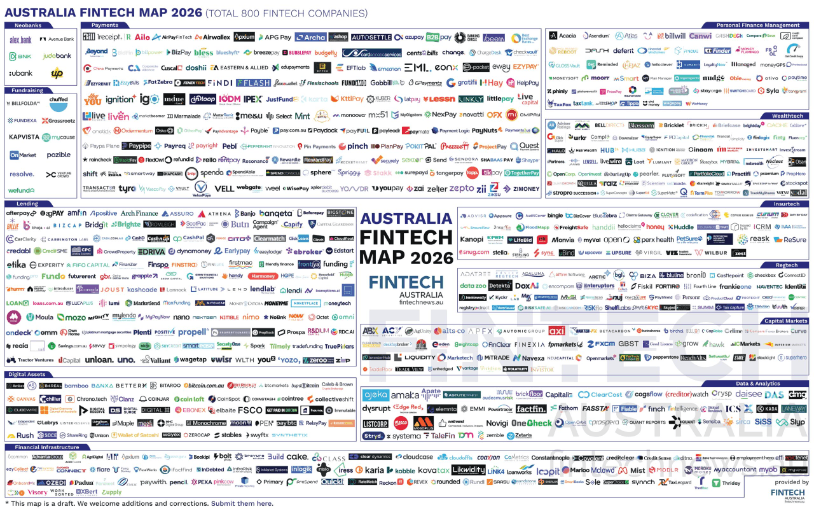
Australia is home to a dynamic fintech industry, comprising 800 fintech companies across various verticals, according to new research conducted by Fintech News Australia. This industry includes both domestic and international players.
The Australia Fintech Map 2026, released in August 2026, provides an overview of this landscape, listing all active fintech companies in the country and categorizes them based on their vertical focus.
The map reveals 12 main verticals, with payments currently leading the market by accounting for 20.8% of all active fintech companies in Australia with 168 ventures. After payments, lending follows with a 17.75% share and 142 companies. Financial infrastructure ranks third, holding a 11.25% share with nine companies.
The research shows that homegrown companies constitute the overwhelming majority of active fintech companies in Australia, accounting for a staggering 96% of the total with 768 companies.
It’s followed by the US with 17 ventures, and the UK with seven. Other jurisdictions represented include Singapore with three companies, New Zealand with two, as well as China, Cyprus, and Spain, each with one.
Featured image: Edited by Fintech News Australia, based on image by DC Studio via Magnific
