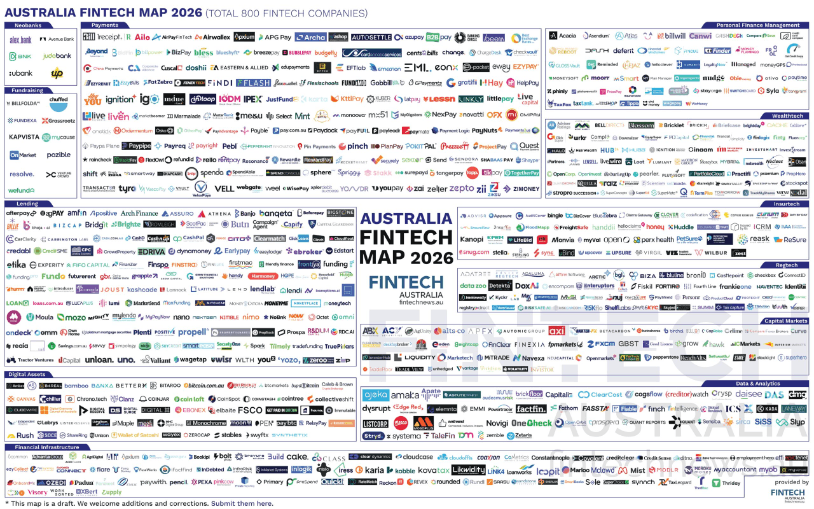


Australia boasts a thriving and dynamic fintech industry, comprising 800 fintech companies across various verticals, according to new research conducted by Fintech News Australia. This industry includes both domestic and international players.
The Australia Fintech Map 2026, released in August, provides an overview of the domestic fintech landscape in Australia. It lists all active fintech companies in the country and categorizes them based on their vertical focus.
The map includes both private and public companies, as well as those that have been acquired. It focuses on ventures that primarily operate in the Australian market, and excludes global fintech firms headquartered overseas and which have only expanded to Australia. Additionally, the list excludes companies that are not pure fintech companies.

Sectoral trends
The Australia Fintech Map 2026 reveals that 12 main verticals now comprise the Australian fintech market.
Payments currently leads the market, accounting for 20.8% of all active fintech companies in Australia with 168 ventures. These companies use software and modern networks to make sending, receiving, and managing money faster, cheaper, and easier for people and businesses.
Notable players in this sector include Airwallex, a global cross-border payment specialist; EML Payments, which provides prepaid card solutions; and Tyro, a merchant acquiring bank.
After payments, lending follows, accounting for 17.75% of all active fintech companies with 142 ventures. These companies use software, digital platforms, and data science to automate and speed up the loan process. They include Wisr, an ASX-listed wellness-focused consumer lender; Afterpay, a buy now, pay later (BNPL) provider part of Block; and Latitude, a consumer credit provider.
Financial infrastructure ranks third holding a 11.25% share with 9 companies. These business-to-business (B2B) companies provide the foundational pipes powering banks, corporate platforms, and other financial services providers. They include Credit Clear, which delivers end-to-end receivables and collections solutions to organizations worldwide; finPower Connect, a lending and loan management software infrastructure platform; and Loanworks, a provider of software and outsourcing solutions to finance providers.
Other prominent fintech verticals in Australia include:
- Wealthtech, accounting for 8.9% of active fintech companies or 71 ventures. Notable players include Spaceship, a digital superannuation and micro-investing fund targeting younger demographics with tech-forward portfolios; Stockspot, a digital investment adviser; and InvestSMART, a low-cost digital investing platform;
- Digital assets, holding a 7% share with 60 companies and represented by Immutable, a Web3 gaming platform and layer-2 scaling solution for non-fungible tokens (NFTs) on Ethereum; Synthetix, a derivatives liquidity protocol; and Swyftx, a cryptocurrency exchange; and
- Regtech, with a 6.9% share and 55 ventures, and represented by Arctic Intelligence, an enterprise risk management platform; FrankieOne, a dominant identity verification platform; and LAB Group, a digital onboarding and compliance provider.

Homegrown ventures dominate the market
The Australia Fintech Map 2026 reveals that homegrown companies constitute the overwhelming majority of active fintech companies in Australia, accounting for a staggering 96% of the total with 768 companies.
It’s followed by the US with 17 ventures and a 2.125% share, and the UK with a 0.875% share and seven companies. Other jurisdictions represented include Singapore with three companies, New Zealand with two, as well as China, Cyprus, and Spain, each with one.
Prominent foreign fintech companies that have set their sights on the Australian market include FP Markets, an online broker headquartered in Cyprus; Nudge, a financial wellbeing and education platform based in the UK; Harmoney, an online consumer-direct personal lender from New Zealand; Stables, a stablecoin payment infrastructure provider from Singapore; and Cover Genius, an insurtech startup that offers embedded protection from the US.

The fintech industry has become a pivotal force in Australia’s national economy, driving growth and employment. In 2024-2025, the sector directly added AUD 13.6 billion (US$9.3 billion) in value to the country’s GDP, with a further AUD 10.6 billion (US$7.4 billion) in indirect value generated through their demand for goods and services from upstream industries, according to a 2026 study by Deloitte. The sector employed roughly 50,200 full-time equivalent (FTE) staff, while indirectly supporting another 59,000 FTE roles.
Australia Fintech Map 2026